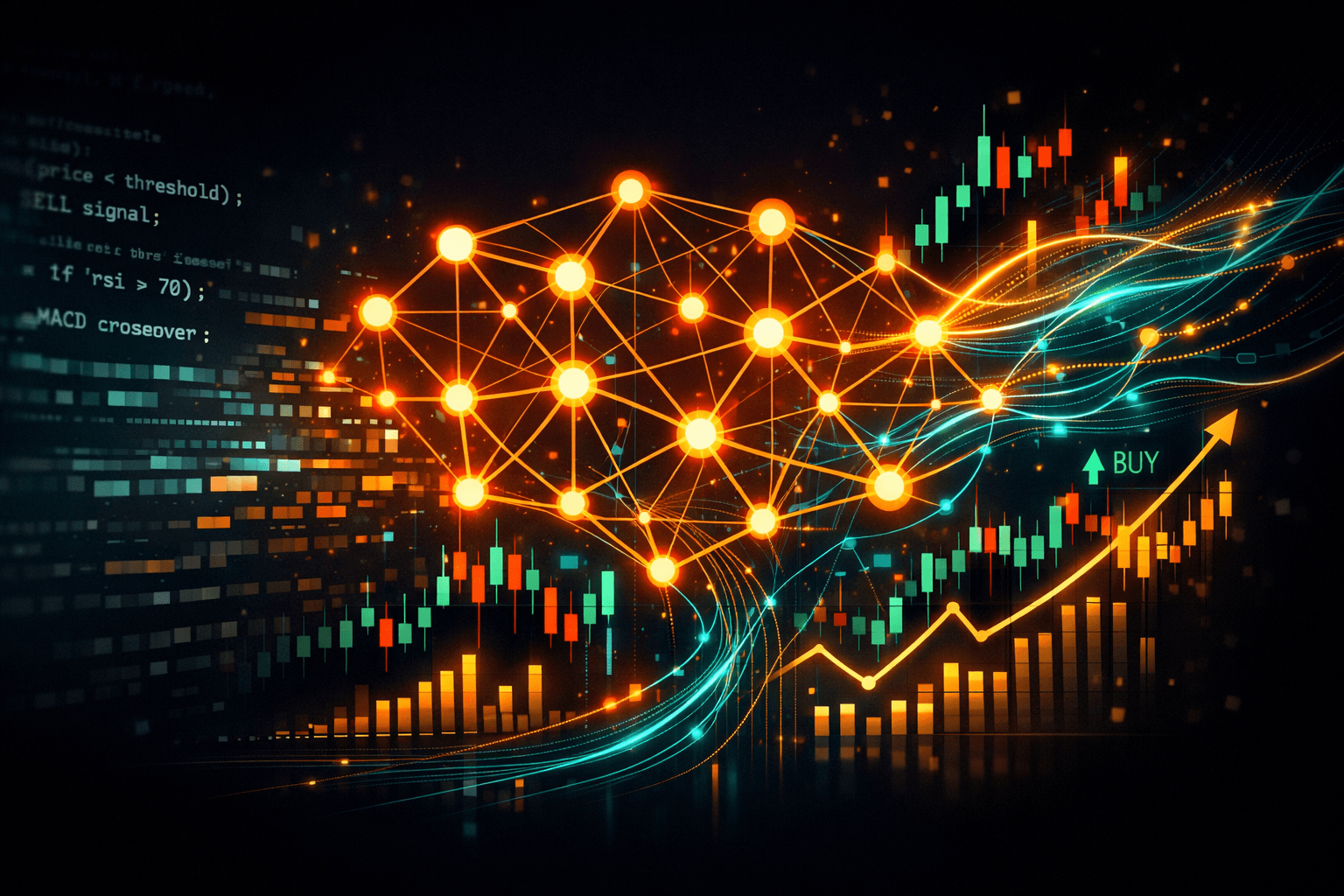
The algorithmic trading landscape is undergoing its biggest transformation in decades. The global market has grown from $21.89 billion in 2025 to $25.04 billion in 2026, with projections reaching $44.34 billion by 2030. At the center of this shift is a fundamental change in how trading algorithms think, learn, and execute.
Traditional rule based systems that followed static "if this, then that" logic are rapidly giving way to machine learning models that adapt, evolve, and improve with every market cycle. For traders, fintech companies, and investment firms, understanding this transition is not just interesting. It is essential for staying competitive.
What Are Rule Based Trading Algorithms
Rule based algorithms operate on predefined conditions set by human traders. These systems follow explicit instructions like "buy when the 50 day moving average crosses above the 200 day moving average" or "sell when RSI exceeds 70."
These systems have powered quantitative trading for decades and offer clear advantages:
Transparency. Every decision can be traced back to a specific rule. There is no ambiguity about why a trade was executed.
Consistency. The algorithm executes the same way every time, removing emotional bias from trading decisions.
Speed. Automated execution happens in milliseconds, far faster than any human trader.
However, rule based systems have a critical limitation. They cannot adapt to conditions they were not explicitly programmed to handle. When markets behave in ways that fall outside their predefined rules, these systems either freeze, generate false signals, or continue executing strategies that no longer work.
How Machine Learning Trading Algorithms Work Differently
Machine learning algorithms do not follow static rules. Instead, they learn patterns from historical and real time data, then continuously refine their strategies based on outcomes.
There are several types of ML models used in modern trading:
Supervised Learning Models. These algorithms train on labeled historical data to predict future price movements, volatility, or market direction. They learn relationships between hundreds of input features like price action, volume, order flow, sentiment data, and macroeconomic indicators.
Reinforcement Learning Models. These systems learn through trial and error, receiving rewards for profitable trades and penalties for losses. Over thousands of simulated trading sessions, they develop sophisticated strategies that no human could manually program.
Deep Learning Networks. Neural networks with multiple layers can identify complex, nonlinear patterns in market data that traditional statistical methods miss entirely. They excel at processing unstructured data like news articles, earnings calls, and social media sentiment.
Ensemble Methods. Modern trading systems often combine multiple ML models, using techniques like random forests or gradient boosting to aggregate predictions from diverse algorithms, reducing the risk of any single model failing.
Why ML Algorithms Are Outperforming Rule Based Systems
The performance gap between ML and rule based systems has widened significantly in recent years. Here is why:
Adaptive Market Response
Markets are not static. Volatility regimes change, correlations between assets shift, and new patterns emerge constantly. Rule based systems using fixed parameters from 2024 may be completely ineffective in 2026 market conditions.
ML models continuously retrain on new data, adapting their strategies to current market dynamics. When a new pattern emerges, the model identifies and incorporates it without human intervention.
Processing Multimodal Data
Traditional algorithms analyze price and volume data. ML systems can simultaneously process:
Price and volume data across multiple timeframes. Order book depth and trade flow patterns. News sentiment from thousands of sources in real time. Social media signals and retail trader positioning. Macroeconomic indicators and central bank communications. Satellite imagery and alternative data sources.
This ability to synthesize diverse information streams gives ML algorithms a significant edge in predicting market movements.
Pattern Recognition at Scale
Human traders and rule based systems can monitor a handful of indicators across a few dozen instruments. ML algorithms can simultaneously analyze thousands of features across hundreds of markets, identifying correlations and patterns that would be impossible for humans to detect.
For example, an ML model might discover that a specific combination of currency pair movements in Asian markets, combined with changes in commodity futures open interest, reliably predicts a particular stock sector rotation 48 hours later. No human trader would think to look for such a relationship, but the algorithm finds it through systematic pattern analysis.
Reduced Overfitting With Modern Techniques
Early criticism of ML in trading focused on overfitting, where models memorize historical patterns that do not repeat. Modern ML trading systems address this through:
Walk forward optimization that tests strategies on truly unseen data. Regularization techniques that penalize overly complex models. Cross validation across different market regimes and time periods. Ensemble methods that reduce dependence on any single model. Synthetic data generation to test robustness against scenarios that have not occurred yet.
Real World Applications in 2026
High Frequency Market Making
ML algorithms now dominate market making operations, dynamically adjusting bid ask spreads based on predicted short term volatility, inventory risk, and order flow toxicity. These systems process millions of data points per second and adapt their behavior in real time.
Sentiment Driven Trading
Natural language processing models analyze earnings calls, news articles, regulatory filings, and social media posts to generate trading signals. The best systems understand context, sarcasm, and implied meaning rather than simply counting positive and negative keywords.
Portfolio Optimization
ML models are replacing traditional mean variance optimization with approaches that account for regime changes, tail risks, and non normal return distributions. Reinforcement learning agents can dynamically rebalance portfolios based on changing market conditions and investor objectives.
Risk Management
Predictive models now forecast potential drawdowns, liquidity crises, and correlation breakdowns before they occur. These systems monitor thousands of risk factors simultaneously, providing early warning signals that rule based risk limits would miss.
Building Your ML Trading Strategy: Key Considerations
If you are considering the transition from rule based to ML powered trading, here are the critical factors:
Data Quality Is Everything
ML models are only as good as the data they learn from. Ensure your historical data is clean, properly adjusted for corporate actions and survivorship bias, and comprehensive enough to cover multiple market regimes.
Start Hybrid, Not Pure ML
The most successful trading firms do not abandon rule based logic entirely. They use ML to enhance and adapt rule based frameworks. For example, an ML model might dynamically adjust the parameters of a moving average crossover strategy based on current volatility conditions, combining the interpretability of rules with the adaptability of machine learning.
Infrastructure Matters
ML trading requires significant computational resources for model training, backtesting, and real time inference. Cloud computing platforms have made this more accessible, but you still need robust infrastructure for data pipelines, model serving, and execution systems.
Regulatory Compliance
Financial regulators are increasingly scrutinizing algorithmic trading systems, particularly those using AI. Ensure your ML models include proper audit trails, explainability features, and risk controls that satisfy regulatory requirements.
Continuous Monitoring
ML models can degrade over time as market conditions evolve beyond their training data. Implement continuous monitoring systems that track model performance, detect distribution shifts, and trigger retraining when necessary.
The Future: What Comes Next
The convergence of several trends is accelerating ML adoption in trading:
Quantum Computing. Early quantum algorithms are beginning to solve portfolio optimization problems that are computationally intractable for classical computers.
Federated Learning. Trading firms are exploring ways to collaboratively train models without sharing proprietary data, potentially creating more robust algorithms without compromising competitive advantages.
Foundation Models for Finance. Large language models fine tuned on financial data are emerging as general purpose tools for market analysis, report generation, and strategy development.
Regulatory Technology. AI powered compliance systems are making it easier for smaller firms to implement sophisticated algorithmic trading while meeting regulatory requirements.
Conclusion
The shift from rule based to ML powered trading algorithms is not a trend. It is a fundamental transformation of how financial markets operate. With the algorithmic trading market projected to nearly double by 2030, firms that embrace machine learning today will have a significant competitive advantage.
Whether you are a retail trader exploring automated strategies, a fintech startup building trading products, or an established firm modernizing your technology stack, the time to invest in ML trading capabilities is now.
At Macaw Digital Solutions, we specialize in building custom algorithmic trading systems, from traditional rule based platforms to cutting edge ML powered solutions. Our team has expertise in MetaTrader, NinjaTrader, TradingView, and fully custom trading infrastructure.
Explore our trading and algorithmic solutions or request a free consultation to discuss how AI powered trading can transform your strategy.